
How to Shop Sustainably This Holiday Season (Without Losing the Joy)
Cities look magical this time of year.
Lights everywhere, window displays glowing, shopping bags swinging down every block.
But if you zoom out even a little, you see the other holiday aesthetic: mountains of trash outside the same stores we rush into for “deals,” and an invisible trail of waste that ends up in landfills, incinerators, and soils far away from the sparkly streets.
In the U.S., waste jumps during the holidays, returns spike, and more than half of adults say they receive at least one unwanted gift. That is a lot of plastic, textiles, electronics, and packaging that spend more time in closets, garbage bags, and landfills than in actual use. The goal of this guide is not to tell you “don’t buy anything.” It is to help you shop in a way that honors people, soil, air, and the communities that carry our waste long after the decorations come down.

The modern holiday seasonThe modern holiday season is built on overconsumption. We buy fast, often under pressure, and the environmental “receipt” shows up somewhere else: in extraction sites, in factory towns, in shipping corridors, and under the ground where our trash is buried.
A few patterns drive the problem:
We overbuy “just in case,” and many of those items become clutter, returns, or waste.
We favor cheap, trendy, synthetic products that are hard to repair or recycle.
We rely heavily on fast shipping, excessive packaging, and last‑minute decisions.
From a soil and environmental justice perspective, this matters because everything we buy eventually becomes something the environment has to absorb. Synthetic fabrics shed microfibers into waterways and urban soils. Plastics and packaging persist for decades. Landfills and incinerators are disproportionately sited near communities that already face multiple environmental burdens. Holiday “cheer” for some becomes long‑term exposure for others.
Principle #1 – Buy less, but better
“Less but better” is the foundation of sustainable shopping. The most sustainable item is the one you already have. The second most sustainable is the one you buy thoughtfully and use for a long time.
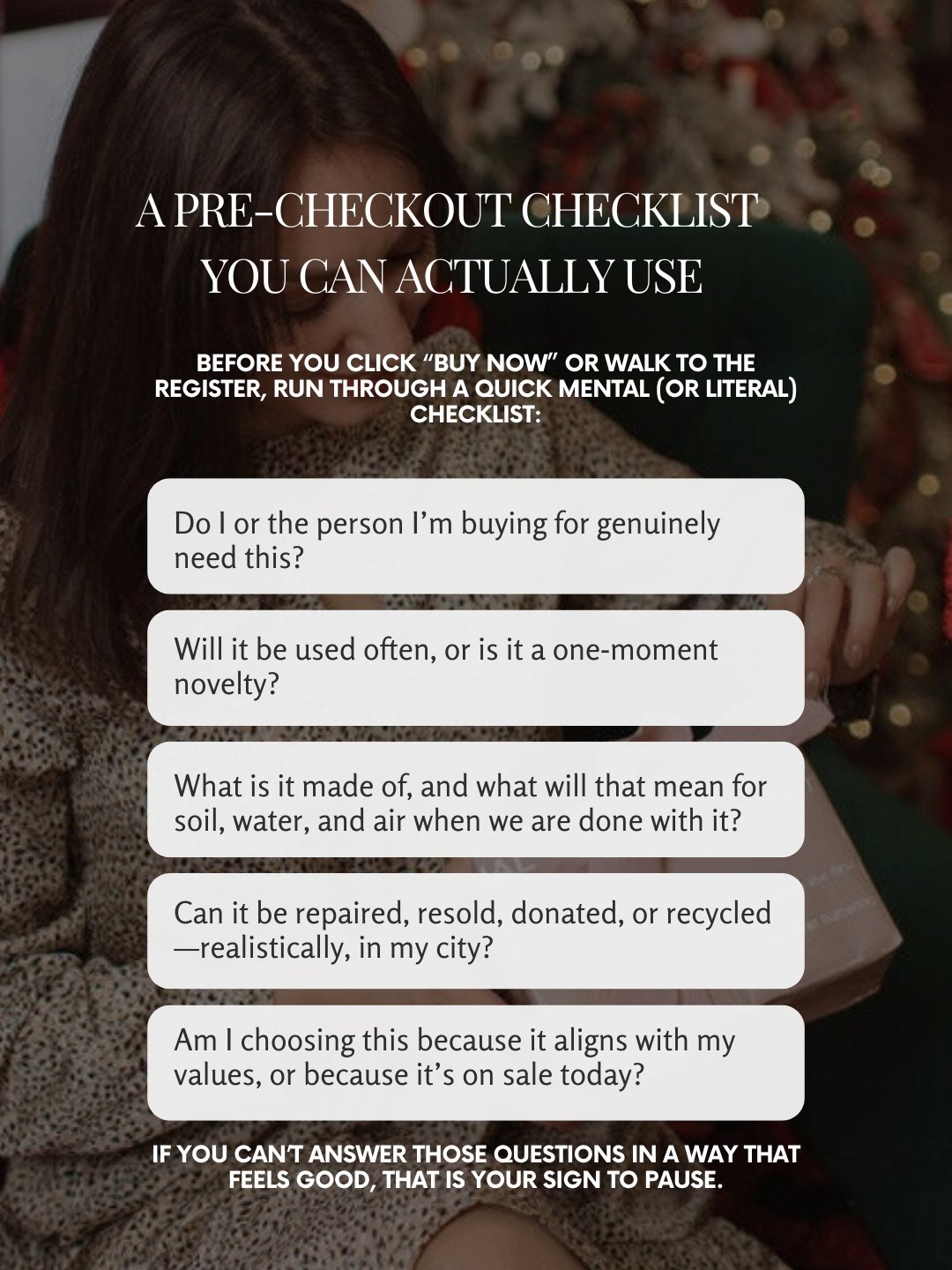
Before you buy, pause and ask:
Do I already own something that does this job?
Will I realistically use or wear this 30 times or more?
Will the person I’m buying for actually use this, or am I projecting my taste onto them?
When you do choose to buy:
Prioritize durability: solid seams, sturdy hardware, repairable materials.
Prefer timeless over hyper‑trendy; you want pieces that still feel relevant in 3–5 years.
Think “future you”: will you be glad to see this item in your home or closet a year from now, or will it feel like clutter?
From a soil lens, “less but better” means less extraction of raw materials, fewer truckloads of goods and packaging moving around, and less pressure on landfills and informal waste sites. By buying an object, you are also buying the future waste profile of that object.
Principle #2 – Choose lower‑impact materials and brands
Not all products are equal in their impact. Material choice is one of the most concrete levers you have.
When possible, look for:
Recycled content: textiles made from recycled fibers, recycled metals in jewelry, or accessories made from reclaimed materials.
Responsible natural fibers: organic cotton, linen, hemp, wool from well‑managed systems, or other fibers that avoid heavy pesticide use and toxic dyeing processes.
Repair‑friendly design: shoes that can be resoled, clothing that can be tailored, electronics with replaceable parts.
For brands, simple filters help:
Check if they share information about their supply chain, labor standards, and environmental commitments.
Look for meaningful certifications (for example, organic textile standards, Fair Trade, or other third‑party verifications), but remember that smaller, local makers may be doing great work without having the budget for formal labels.
Notice what they say about repair, resale, or take‑back programs. A brand that plans for the afterlife of its products is usually thinking beyond pure volume.
Every fiber and material has a footprint, but choosing more durable, recycled, or responsibly sourced options reduces the burden on soils, waterways, and the communities near extraction and production sites.
Principle #3 – Rethink what counts as a “gift”
A “gift” does not have to be a brand‑new object in a shiny box. The most meaningful and sustainable gifts often take up less physical space and create less waste.
Consider:
Experiences: classes, workshops, museum memberships, performances, or shared meals.
Skills and services: offering childcare, tutoring, editing a CV, home organizing, or garden help.
Donations: contributions to organizations working on soil health, environmental justice, food security, or local mutual aid, made in someone’s name.
For physical items, expand what “new” looks like:
Secondhand and vintage: carefully chosen pre‑loved pieces (clothing, books, home goods) that match someone’s style or interests.
Upcycled goods: items made from reclaimed textiles, wood, or metal, which extend the life of existing materials instead of demanding more extraction.
Local handmade: work from neighborhood artists and makers, where your money supports relationships and community, not just a supply chain.
Reframing gifts this way shifts value away from volume and toward thoughtfulness, connection, and impact. It also means less new material entering the system—and less waste that soils and communities have to absorb later.
Principle #4 – Cut packaging and logistics waste
Even when the item itself is relatively sustainable, the way it reaches you matters. Holiday shipping and packaging add a huge layer of cardboard, plastic, and emissions.
You can dial that down by:
Grouping online orders: instead of several separate purchases, batch them so you receive fewer boxes and fewer delivery trips.
Choosing slower shipping: expedited shipping often means less efficient routes and more partially filled trucks or planes.
Opting out of extra gift packaging: many retailers offer “gift wrap” that adds non‑recyclable materials; skip it and wrap items yourself more sustainably.
Using low‑waste wrapping: plain paper that can be recycled, reusable cloth wraps, tote bags that are part of the gift, or jars and containers that can live on in someone’s kitchen or bathroom.
When you think about packaging as future landfill content or future microplastic fragments in soil, the motivation to simplify and reduce becomes much clearer.
Principle #5 – Shop local and support better systems
Where you spend is as important as what you buy. Local and values‑aligned businesses often keep more economic value in the community and can have smaller transport footprints.
Ways to lean into this:
Prioritize neighborhood shops, markets, and makers where you can talk to the person who made or curated the item.
Seek out businesses that offer repair services, trade‑ins, or secondhand sections. A tailor or shoe repair shop can extend the life of items you already own or plan to gift.
For workplace or institutional gifting, push for sustainable options: useful, durable items, locally made goods, or donations in lieu of generic branded swag that is headed straight for the junk drawer.
Sustainable shopping is about shifting demand toward systems that value durability, repair, and local resilience over disposability and volume.
Holiday shopping might feel distant from soil, but it is connected every step of the way—from the cotton field to the copper mine to the landfill cap. This season, let your gifts tell a story that feels good in the places you love—from the sidewalks of your city to the soils that hold its history.