
Material Intelligence at the Textile Museum of Prato
We went to Tuscany for the soil. SUITMA — the international conference on Soils of Urban, Industrial, Traffic, Mining, and Military Areas — was based in Pisa last year, and the program had us out in the field for days: sustainable urban experiments, green infrastructure projects, soil restoration sites. When the scheduled sessions wrapped and we suddenly had a few free hours, a small group of us decided to visit a textile museum in Prato.
We stayed until they asked us to leave.
What we found inside wasn’t just a record of how textiles are made. It was a clear, room‑by‑room argument that design and fashion have traded away material intelligence: the concrete knowledge of what things are made from, where they come from, how they behave, and what they cost in labor, chemistry, and soil to exist at all.
A factory that kept its bones
The Museo del Tessuto occupies the former Campolmi industrial complex, a 19th‑century textile factory that once employed hundreds of workers, spanned more than 7,000 square meters, and became a symbol of Prato’s textile tradition.
The ceilings are high and unapologetic. The light is flat and industrial. Walking in, one of my colleagues said, “This feels like a lab.” That tone, serious, direct, grounded in evidence, is what makes the museum extraordinary. Every room is “asking you” to pay close attention to something real and tangiable.
Before the fabric, the ground
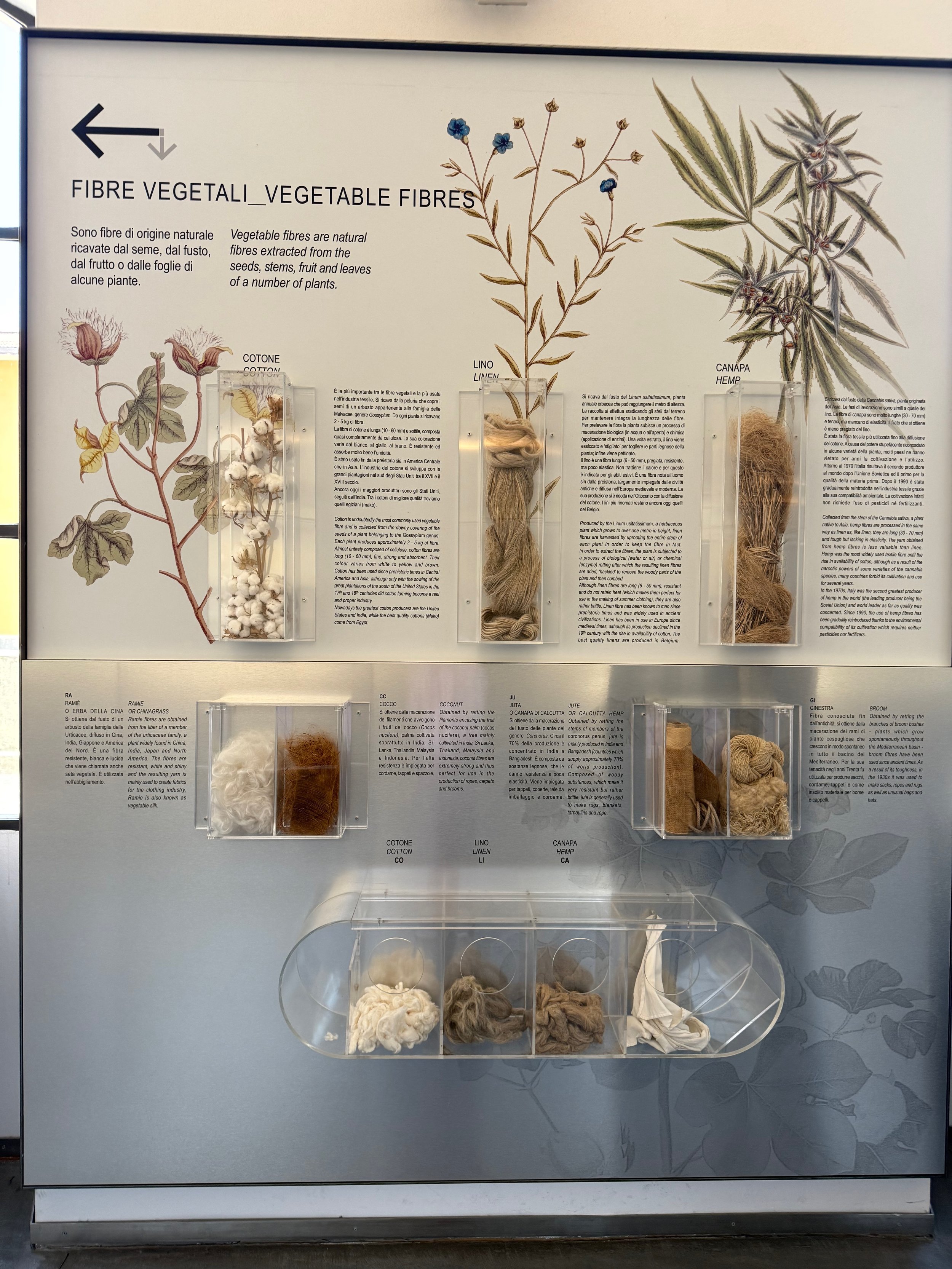
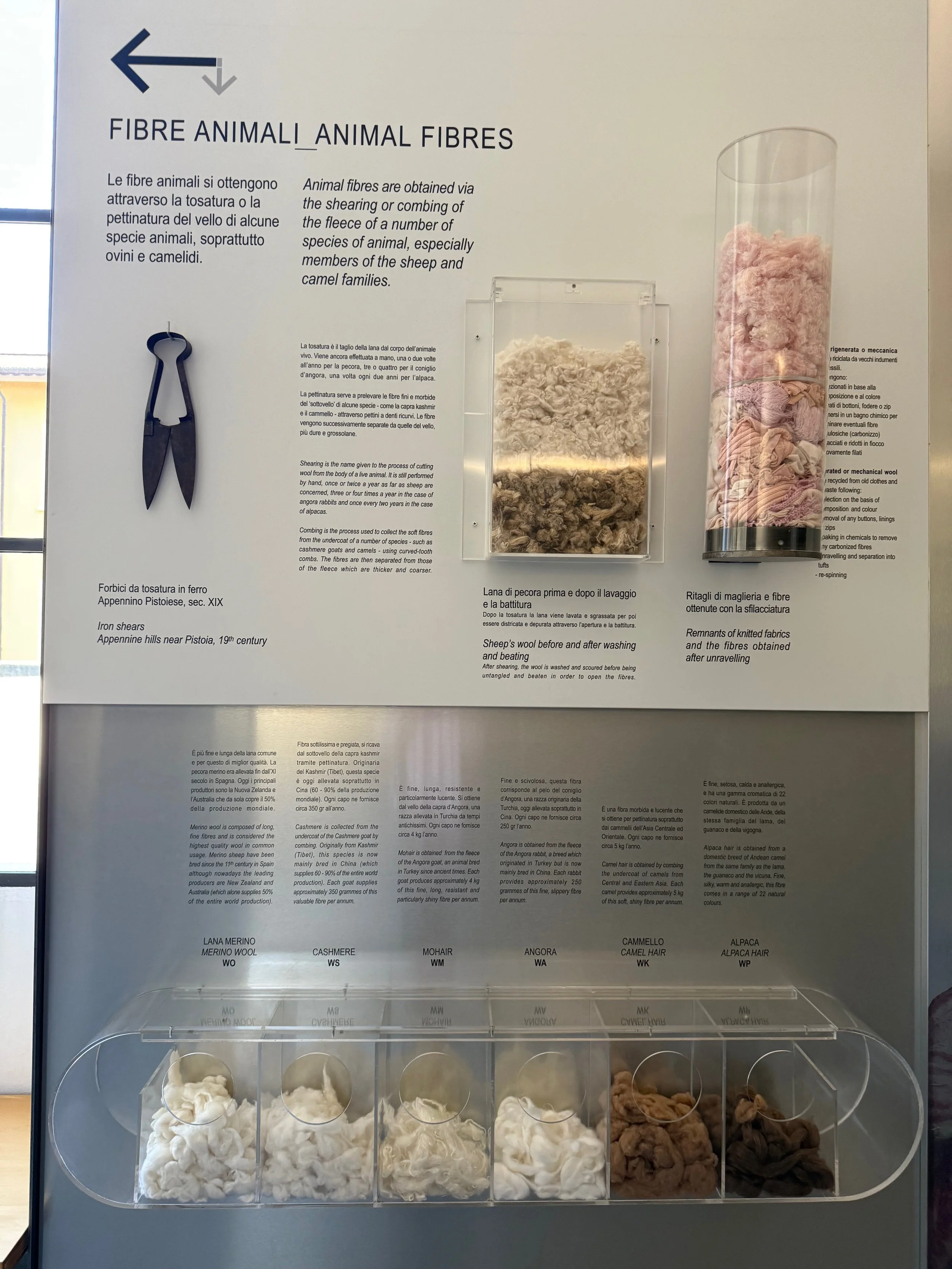
The raw‑materials gallery stopped us: actual source material laid out in acrylic cases with the kind of care you usually reserve for archaeological finds. Cotton bolls still on the branch, fibres barely separated from the seed; a pressed stem of flax; raw wool before and after washing, side by side; silk cocoons next to a diagram showing how a single cocoon can yield up to 1,500 meters of filament.
One of my colleagues stood in front of the vegetable fibres panel for a long time. Then she said, “It’s all just carbon cycling.” She was pointing to something simple and exact: cotton from Gossypium, linen from Linum usitatissimum pulled up by the roots, hemp from the cannabis family — all of it grown in living soil. Every thread on that wall was a record of carbon cycling: a harvest, a season, a particular kind of ground.
This is what material intelligence looks like at its most fundamental level: not just knowing that something is cotton, but understanding the biological and ecological chain that produced it. Most designers today have never seen raw cotton on a branch; most consumers have no mental picture of linen that predates the folded stack on a shelf. That gap — between material and maker, fiber and field — is where the industry’s relationship to its own inputs breaks down.
Everything in those cases, the cotton, the madder root, the flax, starts in soil. Most people in fashion have lost that basic fact.
The intelligence of color
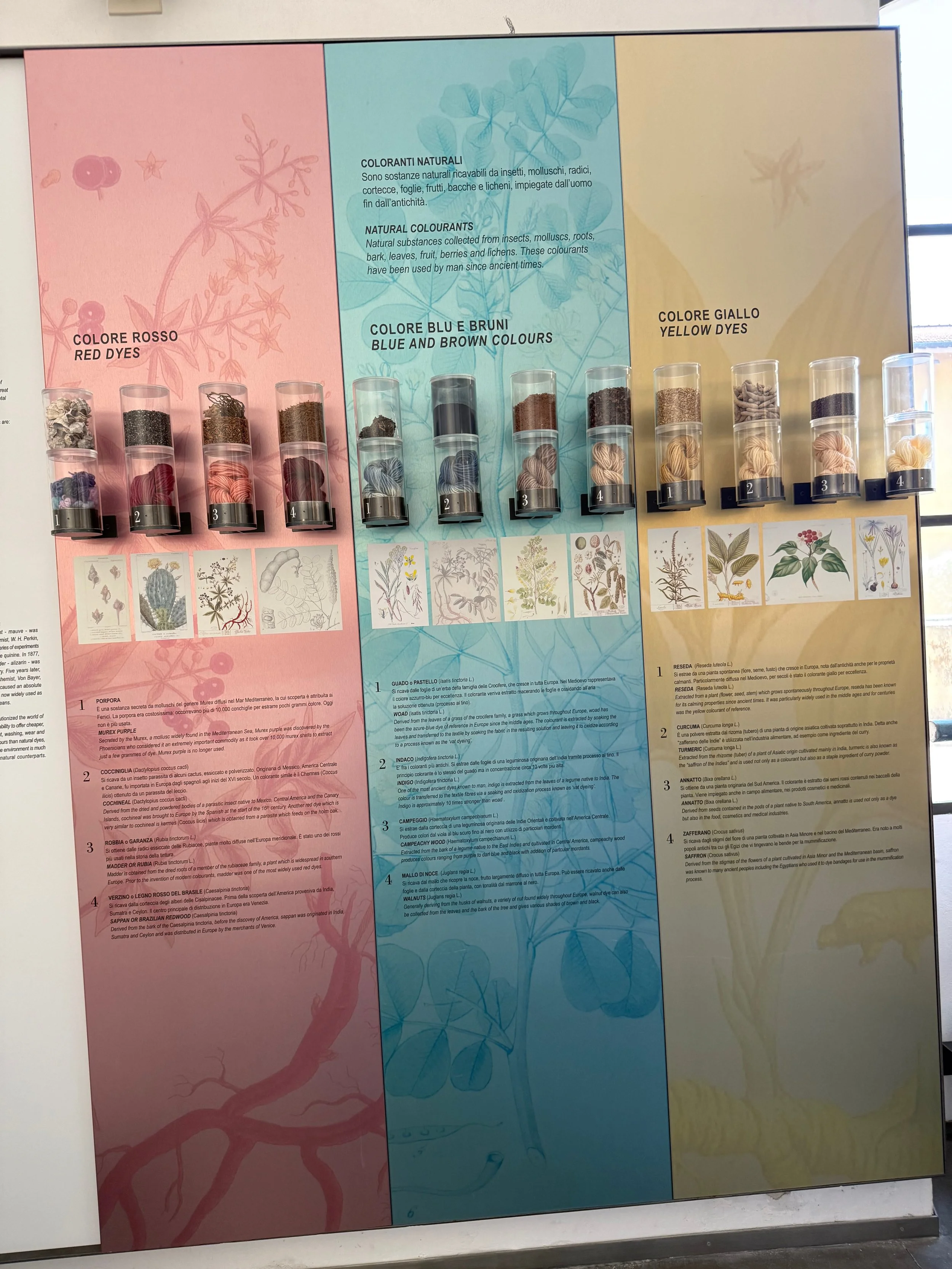
The natural‑dye installation is three large panels — reds, blues and browns, yellows — each lined with rows of specimen tubes filled with dried plant material. Madder root and kermes for reds; indigo and woad for blues; weld, saffron, fustic for yellows, all set against botanical engravings drawn with pre‑photography precision.
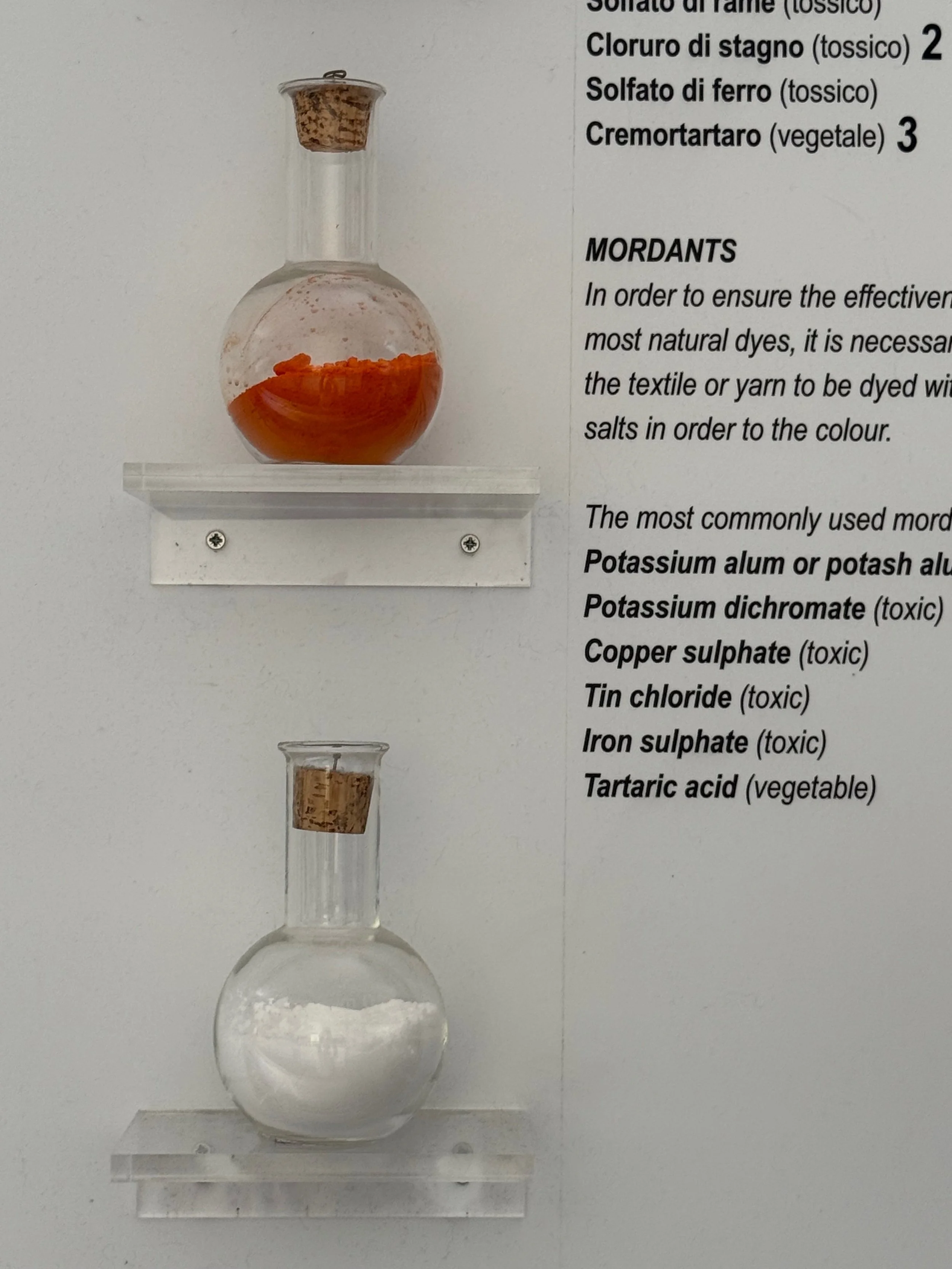
We kept calling things out to each other, the way you do when you’re genuinely excited and already running out of time. But what slowed everyone down was the mordant section: small lab bottles of the mineral salts that make dye bond to fibre — potassium alum, copper sulphate, iron sulphate, tartaric acid. Without these mordants, the color washes out. The chemistry is ancient and exact, built over centuries of trial, and almost completely invisible in the finished cloth. That invisibility is exactly the problem.
Material intelligence usually gets hidden in the final object; the skill is there, but you can’t see it. When that knowledge stops being passed on, and making gets separated from the people who design and sell the product, we don’t just lose “craft” — we lose the ability to make thoughtful choices at all. You can’t make a responsible choice about a material you don’t really understand.
The archive as living memory
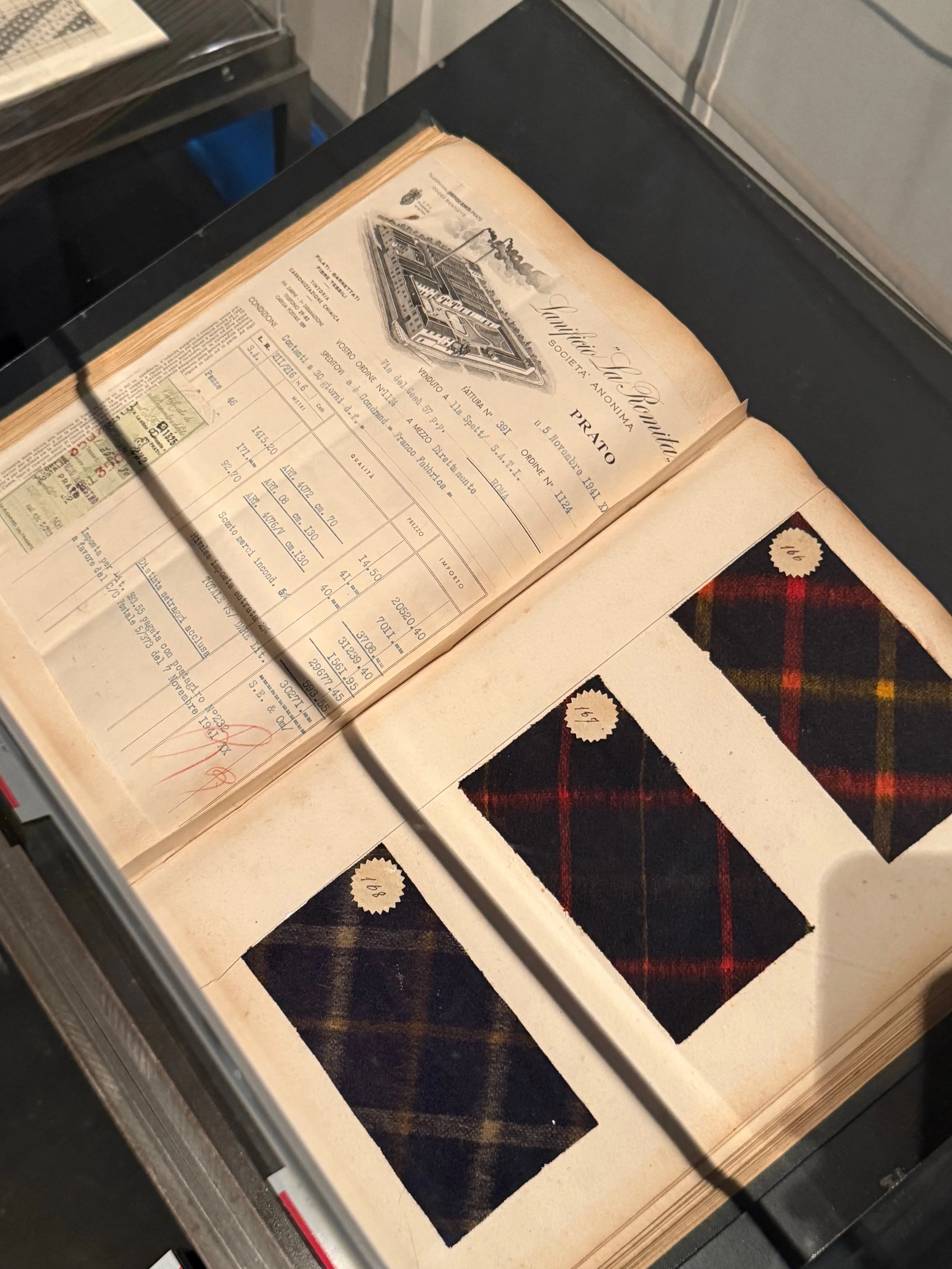
By the time the museum started its soft closing routine, lights dimming behind us, a staff member appearing at the end of a corridor, none of us wanted to leave the glass case of fabric swatch books.
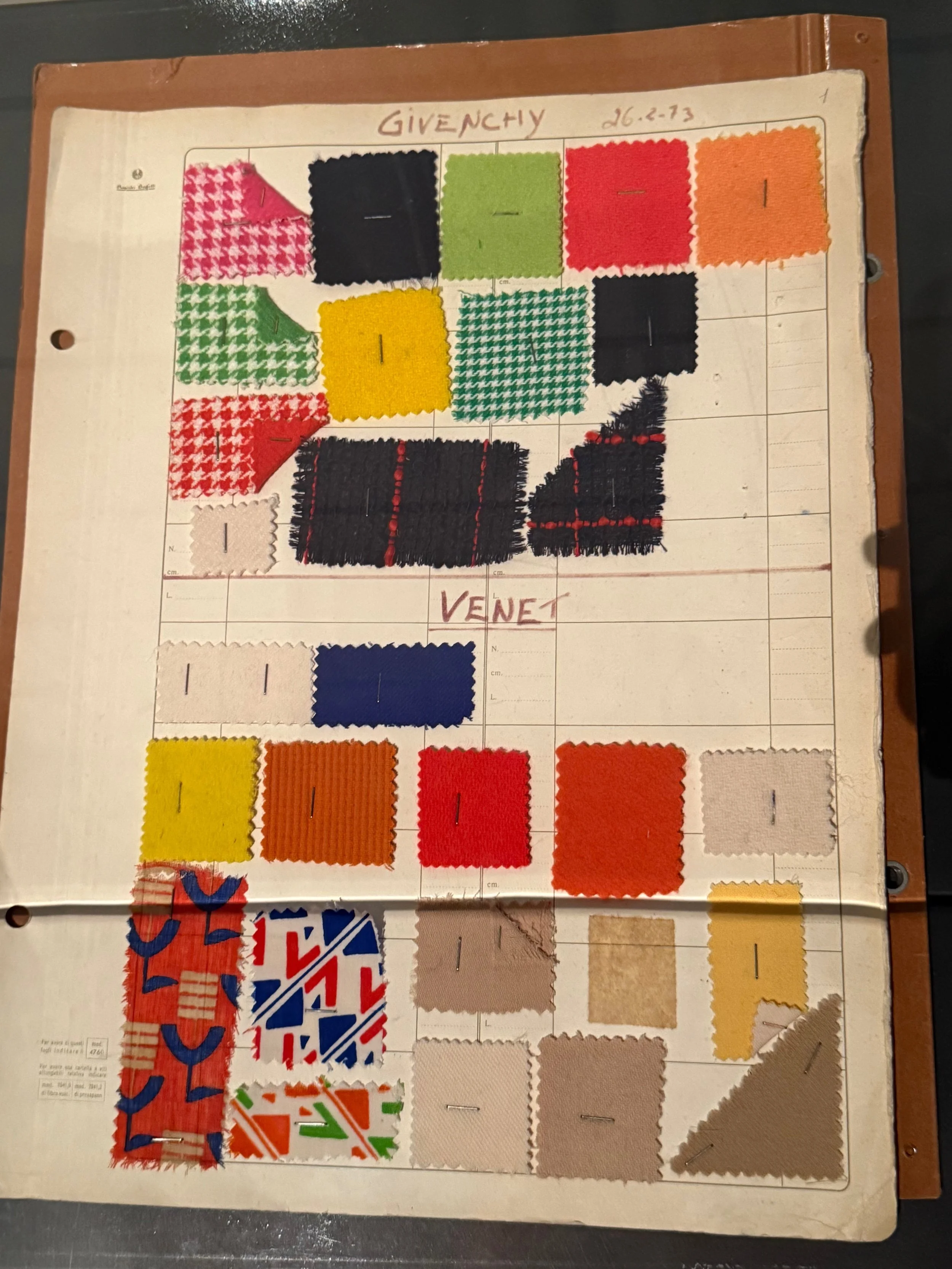
Archive pages from the early 1970s. Swatch books from Givenchy and Venet, dated 1973, dense grids of cut fabric samples — houndstooth in five colorways, plaids in electric blue and tomato red, blocks of mustard, black, cobalt — each one pinned and labelled in an orderly, practiced hand.
What held us was the institutional seriousness of the gesture. Someone, many someones, over decades, decided that these samples were worth keeping, that a specific fabric choice for a specific season was worth naming, dating, filing, preserving. This is material intelligence in archival form: treating a textile decision as a piece of knowledge, not just a commercial move, and assuming that knowledge should be passed forward.
For designers, this should feel urgent. Faster product cycles and digital‑first workflows have accelerated a kind of material amnesia; when seasonal archives vanish, when fabric relationships aren’t documented, when the logic behind a material choice lives only in the memory of one person who has already left the company, that intelligence is simply gone. Prato kept the swatch books as institutional practice.
A century of circular practice
We moved through the industrial‑history section faster than it deserved, because closing time was suddenly very literal. But the numbers have stayed with me.
For more than a century, Prato has built its economy around regenerated wool: collecting used garments from around the world, shredding them to fibre, re‑spinning, re‑weaving them into new cloth. The workers who sorted the rags — the stracciaioli or cenciaioli — became known for a tactile sensitivity so refined they could classify fiber type, blend, and color purely by touch. That skill, trained over years and shared on the factory floor, is its own form of material intelligence: reading material with your hands and knowing exactly what it is and what it could become.
Prato grew into one of the world’s most important hubs for carded woollen fabrics and textile recycling, supporting thousands of businesses and tens of thousands of workers. The district pioneered centralized wastewater treatment and today runs shared purification systems that significantly reduce water use and recover water for industrial processes, with regenerated wool production cutting water consumption by up to 90% compared to virgin fibers.
None of this began as a sustainability strategy. It was built, incrementally, out of industrial common sense: nothing with value should be wasted, and the people handling materials should understand them deeply enough to extract that value. The “circular economy” framework that designers and brands now reach for as a future‑oriented model was, in Prato, simply how you ran a responsible mill.
What we carried home
It’s hard to convey, quickly, why a textile museum lands so hard for a group of soil scientists. But the through‑line is simple: everything in that building begins in the ground. Every color is extracted from a plant rooted in soil; every fiber depends on a growing season, a soil pH, a particular mineral balance. The chain from earth to cloth is long and knowledge‑dense, and most of it is currently invisible to the people making decisions about what gets produced and how.
Material intelligence isn’t a niche skill for chemists and agronomists. It’s the difference between picking a “nice” cotton poplin because it feels good and fits the budget, and choosing (or rejecting) that same cotton knowing where it was grown, what the soil needed to keep producing it, how the mill handled its water and dyes, and what that fabric will mean at the end of its life. It’s working with the full story of a material, not just its hand feel and price per meter.